

 Kookloofeed

“The woman who was ahead of the women, who were ahead of their time.”
—Gloria Steinem on Matilda Joslyn Gage
One hundred and fifty years ago, on July 4, 1876, at Independence Hall in Philadelphia, our founding feminist foremothers were speaking past their own lifetimes—straight to us, the future feminists they called their “daughters.”
That year, Matilda Joslyn Gage and Elizabeth Cady Stanton co-authored a “Women’s Declaration of Rights and Articles of Impeachment Against the Government of the United States.” Susan B. Anthony forcefully presented this declaration to the male leaders gathered at the centennial celebration, despite the men forbidding her to do so.
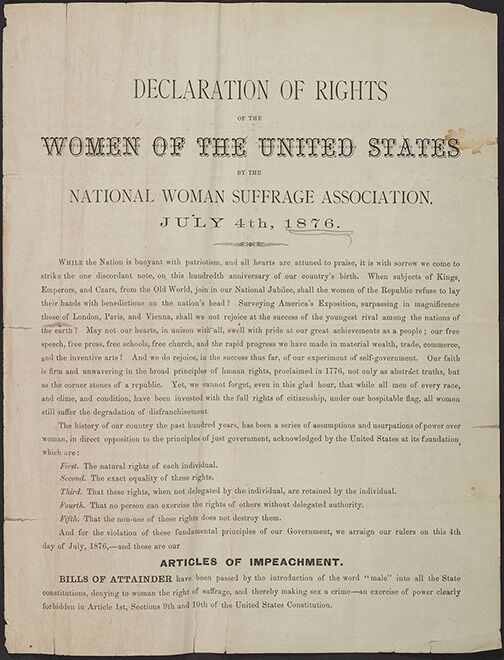
The feminists’ declaration indicted the founding fathers and their male descendants for their “injustice and oppression” against women and demanded “all the civil and political rights that belong to citizens of the United States be guaranteed to us and our daughters forever.”
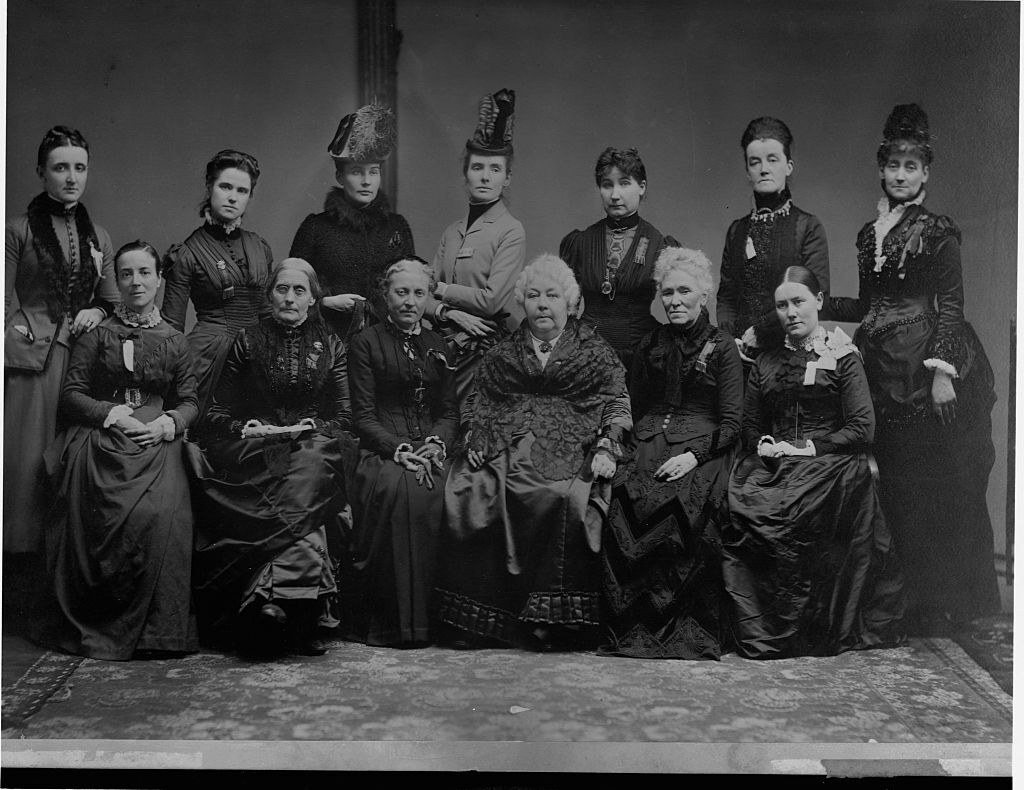
Stanton, Anthony and Gage were known as the “triumvirate” of the 19th-century woman suffrage movement, founding the National Woman Suffrage Association in 1869 and co-authoring the first three volumes of the monumental History of Woman Suffrage.
We’ve all heard of Elizabeth Cady Stanton and Susan B. Anthony. There is a monument in the U.S. Capitol honoring them.
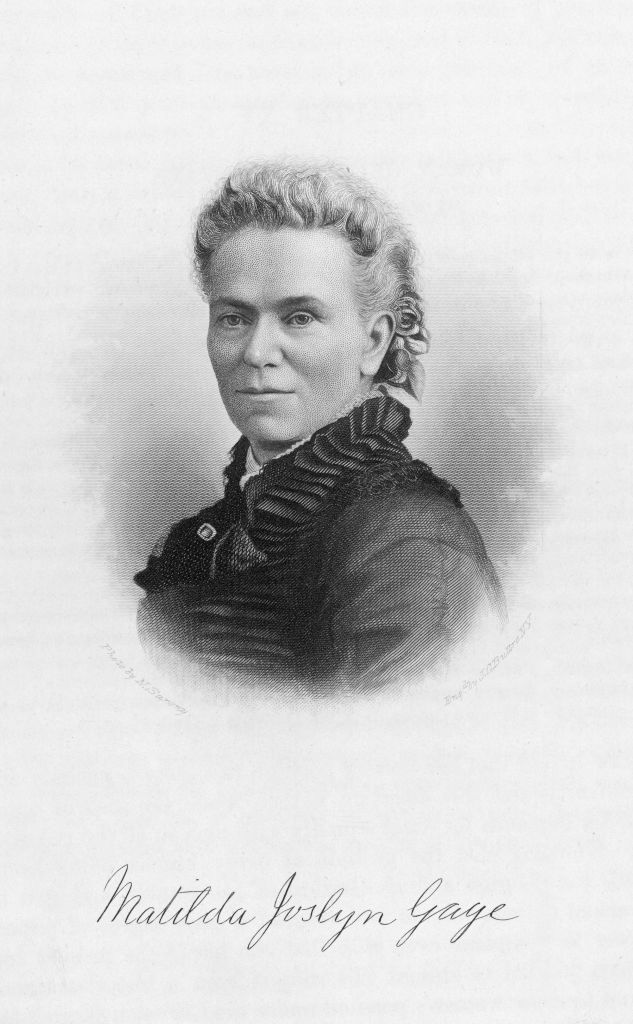
But who is Matilda Joslyn Gage, and why don’t we know more about her?
Born in 1826 near Syracuse, N.Y., Matilda Joslyn Gage grew up in a free-thinking, abolitionist family that was part of the Underground Railroad. Gage was heavily influenced by the nearby Iroquois Confederacy, where Indigenous women were central to political and spiritual life and women’s rights were intrinsic. Gage advocated for the abolition of slavery and for women’s and Native American rights; she was honorarily adopted into the Wolf Clan of the Mohawk Nation in 1893.
Gage attended her first women’s rights convention in 1852, where she met Anthony, and they both became ardent suffragists. After co-founding the National Women’s Suffrage Association, Gage edited and published the National Citizen and Ballot Box, the monthly suffrage newspaper. Under the motto, “The pen is mightier than the sword,” the newsletter published essays advancing women’s constitutional rights and criticizing patriarchal law. The newsletter also advanced women’s inherent abilities and criticized religious authority.
The women of today are the thoughts of their mothers and grandmothers, embodied and made alive. They are active, capable, determined, and bound to win.
Matilda Joslyn Gage
Gage was as much an activist as she was a thinker.
In 1886, along with Lillie Devereaux Blake, she organized a protest at a ceremonial unveiling of the Statue of Liberty. Their group, the New York State Woman Suffrage Association (NWSA), applied to participate, but were denied.
Outraged that liberty was represented by a female figure while “not one single woman throughout the length and breadth of the Land is as yet in possession of political Liberty,” they hired a cattle boat (all they could get), filled it with feminists and circled the island event, using a megaphone to scream out demands for women’s rights. They held signs reading, “American Women Have No Liberty.”
When NWSA joined with the more conservative and religious American Women’s Suffrage Association to form the National American Women’s Suffrage Association in 1890, Gage broke away and formed a new organization: the Women’s National Liberal Union, which focused on advocating for strict separation of church and state, opposing religious influence on government and advancing full civil and political equality for women.
Then Gage set to work writing a book.
In 1893, Gage published Woman, Church and State, a scathing critique of patriarchy and Christianity as its bulwark. She argued that patriarchy was not inevitable but was created by men for their own aggrandizement and was legitimated by Christianity, which made sacred women’s subordination. Gage stressed the need for women to know and interpret history for themselves.
She identified the European witch persecutions as what we now call femicide, a multi-century atrocity that specifically targeted women scientists, healers and resisters. She demanded equal pay for equal work and women’s sexual freedom. She called for a spirituality based on the potency of the feminine generative principle and a bisexual and non-anthropocentric divinity. While condemning patriarchy, she pointed to the superiority of matriarchal Indigenous civilizations.
All this, in 1893!
Throughout all of her work, Gage calls upon the historical tradition of female genius and gives examples of how men have taken credit for women’s inventions throughout history—which came to be known as the “Matilda effect.”
She also influenced her son-in-law, Frank Baum, the author of The Wizard of Oz. Gage’s influence is apparent in a key line from that 1901 book, when that fatuous fraud of a wizard (a stand in for the patriarchal god), confesses:
“One of my greatest fears was the Witches, for while I had no magical powers at all, I soon found out that the Witches were really able to do wonderful things.”
Ironically, Gage is most remembered as the mother-in-law of Baum, the husband of Gage’s daughter Maud—not for her radical feminist actions and vision.
“Everything that Matilda Joslyn Gage wrote about in Woman, Church and State, we are still dealing with today, especially with the rollback in legislation that we’ve been seeing,” said Ciarrai Eaton, executive director of the Matilda Joslyn Gage Center in Fayetteville, N.Y., located in Joslyn Gage’s house, which has been preserved and is open to visitors.
“Even the discussion of taking away the 19th Amendment—women’s ability to vote and women having their own bodily autonomy–all of this they were talking about in the 1850s, ’60s, ’70s, and the fact that here we are at the 250th [anniversary of the United States], still fighting those same fights.”
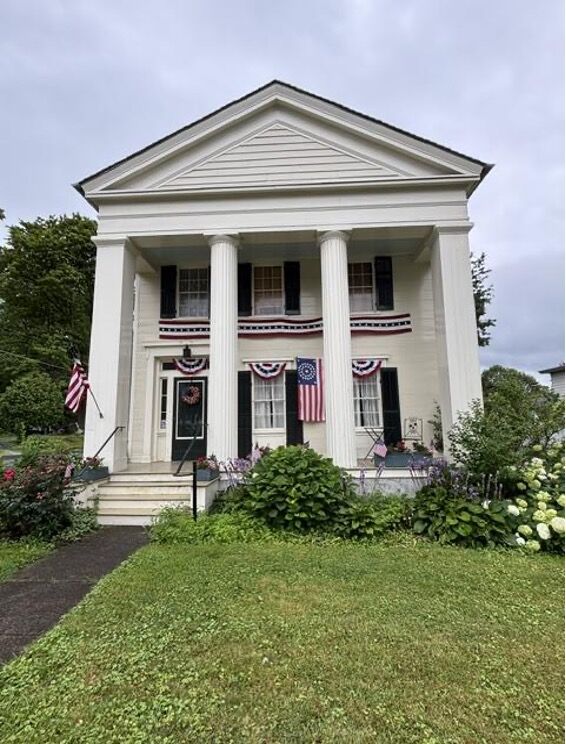
The Fayetteville school board sent a copy of Woman, Church and State to Anthony Comstock, the United States postal inspector tasked with enforcing the 1873 Anti-Obscenity Act, also known as the Comstock Act. (Yes, the same Comstock Act that haunts today’s headlines.)
Comstock blacklisted the book for its discussion of “lust,” an egregious misdirection. What so offended Comstock is Gage’s naming of men’s (including priests’) sexual violence against women and children.
This notoriety, though, suppressed its sales, said Eaton. “She was in financial trouble at the end of her life because her husband had died and [her family’s] store had burnt down, so a lot of her income had disappeared. Because that book got banned, she ended up in quite a bit of financial difficulty at the end of her life.”
Antiabortion forces today are trying to revive the Comstock Act to suppress telehealth abortion, which has been a critical avenue for abortion access after the Supreme Court overturned Roe v. Wade in 2022.
In 1890, Gage began openly encouraging women to refuse to pay their taxes until they obtained the right to vote. She stopped paying taxes on her Fayetteville home and staged a mock funeral in town with a coffin marked “Liberty Died Under Taxation Without Representation.” Authorities in town seized and auctioned her property.
Stanton and Anthony erased Gage from mainstream suffrage history because of her radical challenge to patriarchal religion and her courageous naming of men’s sexual violence against women and girls. They feared she would offend potential allies in the suffrage cause.
In the 1970s, Gage was rediscovered. Woman, Church and State was republished in 1972 by Arno Press, which specialized in reprinting rare and long out-of-print materials, as part of a series edited by pioneering women’s history scholar and Barnard College professor Annette Baxter.
Second-wave radical feminist theologian Mary Daly also condemned patriarchal religion and male violence against women. She came upon Gage’s book. But, before reading, Daly gave it to one of us (Jane, her student at the time), who wrote an extensive research paper on Gage. This led Daly to celebrate Gage in her 1978 book Gyn/Ecology: The Metaethics of Radical Feminism, bringing knowledge of Gage’s work to a new generation of feminists.
The late feminist scholar, historian and writer Sally Roesch Wagner worked tirelessly to create the Matilda Joslyn Gage Foundation and Center, but there has still been very little scholarship on Gage in comparison to other 19th-century suffragists, especially Cady Stanton and Anthony.
Gage was eminently far-seeing—into the past, present and the future.
Her first speech in 1852 began by establishing a historical tradition of women geniuses and ended by extolling the “revolution already commenced.”
In the 1876 Declaration and in all her work, she invoked the “daughters,” recognizing the energetic continuum that is the historic, current and future feminist movement.
Gage deeply understood this, avowing:
“The women of today are the thoughts of their mothers and grandmothers, embodied and made alive. They are active, capable, determined, and bound to win. They have one thousand generations back of them … Millions of women, dead and gone, are speaking through us today.”
If we take Gage at her word, contemporary feminists speak in multiple tones and modes—as our past mothers, with our contemporary sisters and for our future daughters. When we are in that company and participating in that colloquy, we are, like Oz’s Witches, “really able to do wonderful things.”
Throughout this current moment of patriarchal backlash, global feminism continues, inspired with the knowledge, as was Gage, that “woman’s cause is the cause of the world.”
This, she avows, is because feminism’s inevitable “progress will overthrow every existing form of these [patriarchal] institutions. Its end will be a regenerated world.”
You can visit Matilda Joslyn Gage Center in Fayetteville, N.Y., and join the Matilda Society here.
*
A note from Ms. editors: We want to hear from you for The Majority, a new campaign collecting stories about how reproductive freedom has enabled readers to build the lives they want and need. Poll after poll shows a majority of Americans support reproductive healthcare access. Yet public debate overlooks the lives shaped by abortion access, contraception, IVF, miscarriage care, maternal healthcare or comprehensive sex education—countless women who chose to pursue an education, have children, not have children, protect their health and chart their own future. Add your voice and complete the sentence: “Access to reproductive choices gave me the freedom to….” Together, these stories will help show not only why reproductive freedom remains a majority value, but also what it makes possible.


GIPHY App Key not set. Please check settings